Gas to Induction Conversion
The 240-volt circuit, the gas cap-off, the counter cut and the order the trades should arrive in, with questions to ask before anyone opens the wall.
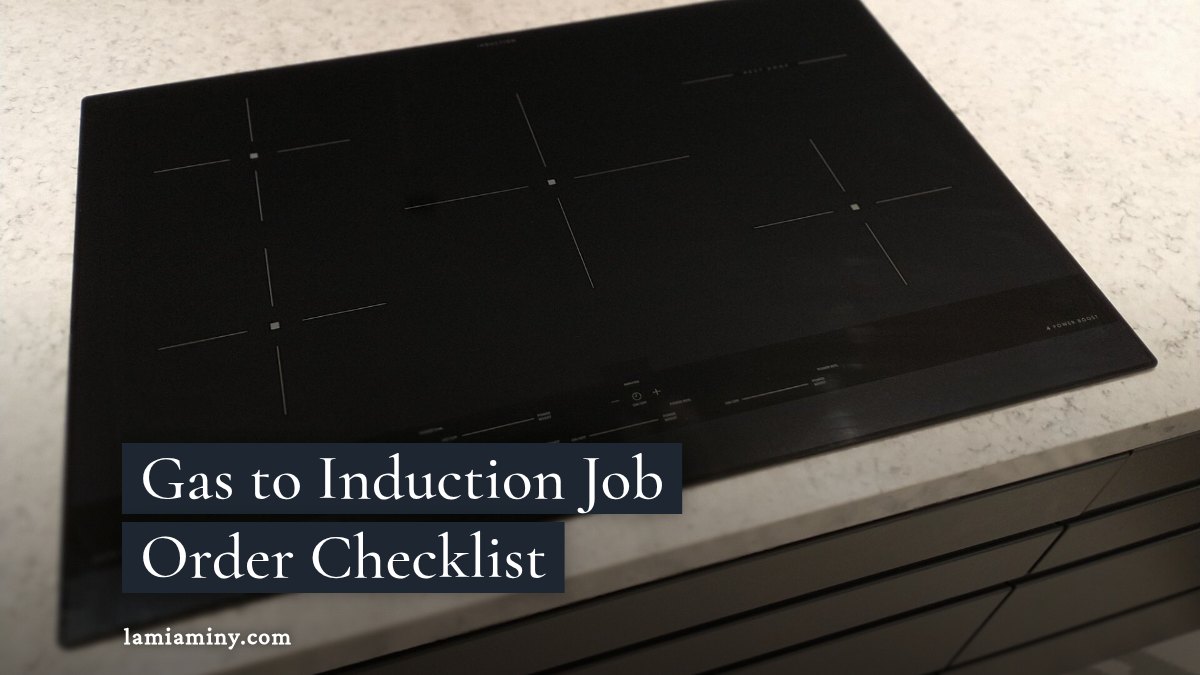
Get the cut sheet for the exact range or cooktop before you collect a single quote. Jaspector, a site that summarizes the residential code, advises getting that sheet early so the circuit is sized correctly and nobody has to redo the work. The breaker, the wire, the outlet and the counter opening all trace back to that one page.
An induction range arrives last and needs its paperwork first. Skip the sheet and the usual mistakes follow: a circuit sized to a guess, a counter cutout that is a few inches off, a gas line left live behind a stove that no longer uses it. Three trades touch this switch (an electrician, a plumber and whoever cuts the cabinets and counter), and each can only do their part well if the one before them has done theirs.
Job Order From First Call to Final Inspection
Here is the sequence the sources point to, from the first phone call to the last signature.
- You and the retailer: pick a cooktop, a slide-in range or a freestanding range, and get the cut sheet.
- You: measure the opening. Yale Appliance, a Massachusetts retailer, says the counter cutout usually differs from the cooktop's own dimensions by a few inches.
- Electrician: sizes the circuit from the nameplate and pulls the permit, since electrical service upgrades usually need one from the town or city.
- Plumber: caps the gas. This can happen before the induction appliance arrives.
- Cabinet and countertop installer: modifies the cabinets or cuts the counter once the dimensions are confirmed.
- Electrician again: plugs in a range or hardwires a cooktop.
- Inspector: signs off on the permitted work.
What Circuit an Induction Range Needs
For a full range, Yale points to a dedicated 240-volt, 50-amp circuit. A cooktop alone generally needs 30 to 40 amps, and MyHome, a New York City source, says a typical 30-inch cooktop needs a 40-amp or 50-amp circuit at peak capacity. Jaspector says no breaker size is universal: 40 or 50 amps is common, but the nameplate controls.
Yale says 50 amps calls for at least 6-gauge copper, and plug-in ranges use a NEMA 14-50R outlet. Summarizing the 2018 International Residential Code, Jaspector says a range gets its own branch circuit, not shared with other kitchen loads, and new range circuits use four wires, though older three-wire setups may remain as legacy conditions.
Two exceptions: some large professional induction ranges, such as the 48-inch Wolf, need two 50-amp circuits, according to Yale. And MyHome says 120-volt induction models exist that plug into standard outlets, at lower total power.
Electrician, Plumber and Countertop Installer
The electrician owns the circuit. MassCEC, the Massachusetts Clean Energy Center, says a licensed electrician must install a 240-volt outlet if the home lacks one. Jaspector says the electrician should coordinate with the cabinet installer and the appliance supplier on outlet location, anti-tip brackets and a flush fit.
The plumber owns the gas. Yale says that in Massachusetts most gas piping work needs a permit and inspection, so a range disconnect is almost always a licensed plumber's job.
The cabinet and countertop installer owns the opening. Slide-in ranges overlap the countertop, so Yale says cabinets often need modifying, while a cooktop needs an experienced person to cut the counter and an electrician to hardwire it. MassCEC adds that the counter and wiring work depends on the size and fuel type of the old appliance.
Rules in New York, Los Angeles and Miami
The sources are local to a few places, so read them that way. In New York City, MyHome says a new dedicated 240-volt induction circuit needs a permit filed by a Licensed Master Electrician, and that some co-op or condo boards want an engineer's Electrical Load Letter confirming the upgrade stays within the unit's share of building amperage. The gas rules above are Massachusetts rules. For Los Angeles, the sources offer only the California rebate below, and for Miami they offer nothing specific, so your own building department decides who pulls which permit.
Induction Conversion Cost and Rebates
The two cost figures in circulation measure different things. MassCEC lists average appliance prices of $900 to $3,000 for ranges, $500 to $2,000 for built-in cooktops and $50 to $500 for portable cooktops. It puts installation at about $100 to $300, with a new 240-volt outlet adding around $300. Yale estimates roughly $3,000 to $3,500 for conversion work on top of the appliance. Neither source explains the gap, but the first reads as a simple swap plus an outlet and the second as the wider job, where gas capping, circuit and counter work may all be needed. An itemized quote for your own scope settles it.
On rebates, the California Energy Commission said HEEHRA Phase I rebates were fully reserved as of August 31, 2026, with no more reservations to be issued. It also says the rebates are not retroactive, so purchases made before a rebate is reserved and approved are not covered. The sources give no equivalent for New York or Miami.
Magnetic Pans, Service Rates and Ventilation
Induction needs magnetic cookware, and Yale says a pan that a magnet sticks to firmly will work. Yale also reported that its induction ranges had a first-year service rate averaging 8.7%, against about 6.9% for gas ranges.
Ventilation still counts. MassCEC says a hood is less critical than with gas but indoor air quality still matters, and MyHome says induction cooking still makes steam, grease and moisture.
Questions to Ask Your Installer
Ask these before the wall or the counter is touched:
- Have you seen the cut sheet for this exact model, and what breaker and wire does the nameplate call for?
- Is there already a 240-volt outlet, or is a new circuit needed?
- Who pulls the permit, and is an inspection included?
- Will a licensed plumber cap the gas line, and when?
- Does the counter or cabinet need cutting, and who does it?
- In a New York co-op or condo, does the board require an Electrical Load Letter?
- Is the ventilation still adequate?
Cutting a Granite or Marble Counter
The last cut in the job has no second chance. Stone counters call for someone with a stone saw and the experience to get through the slab without cracking it, Yale says. For a cooktop, that single pass runs along an opening sized from a cut sheet that was in hand weeks earlier.
Highlights
What circuit does an induction range need?
Yale points to a dedicated 240-volt, 50-amp circuit for a range and 30 to 40 amps for a cooktop alone. Jaspector says the appliance nameplate controls the breaker size.
Who caps the gas line?
A licensed plumber, according to Yale, and it can happen before the induction range arrives.
What does a gas to induction conversion cost?
MassCEC puts installation at about $100 to $300, plus around $300 for a new 240-volt outlet. Yale estimates roughly $3,000 to $3,500 for conversion work on top of the appliance, which likely covers a wider scope.
Sources
- Questions to Ask Your Appliance Salesperson or Induction Cooktop Installer
- 6 Steps to Convert Your Gas Range to Induction
- NYC Induction Cooktop Requirements: Electrical Codes Guide
- Electric Range Circuit Under IRC 2018 | Jaspector
- Inflation Reduction Act Residential Energy Rebate Programs | California Energy Commission