Stair Lift vs Home Elevator vs Ramp Costs and Permits
Costs for a stair lift, home elevator and entry ramp, the permit and code rules published for elevators, platform lifts and ramps, and which trade to call.
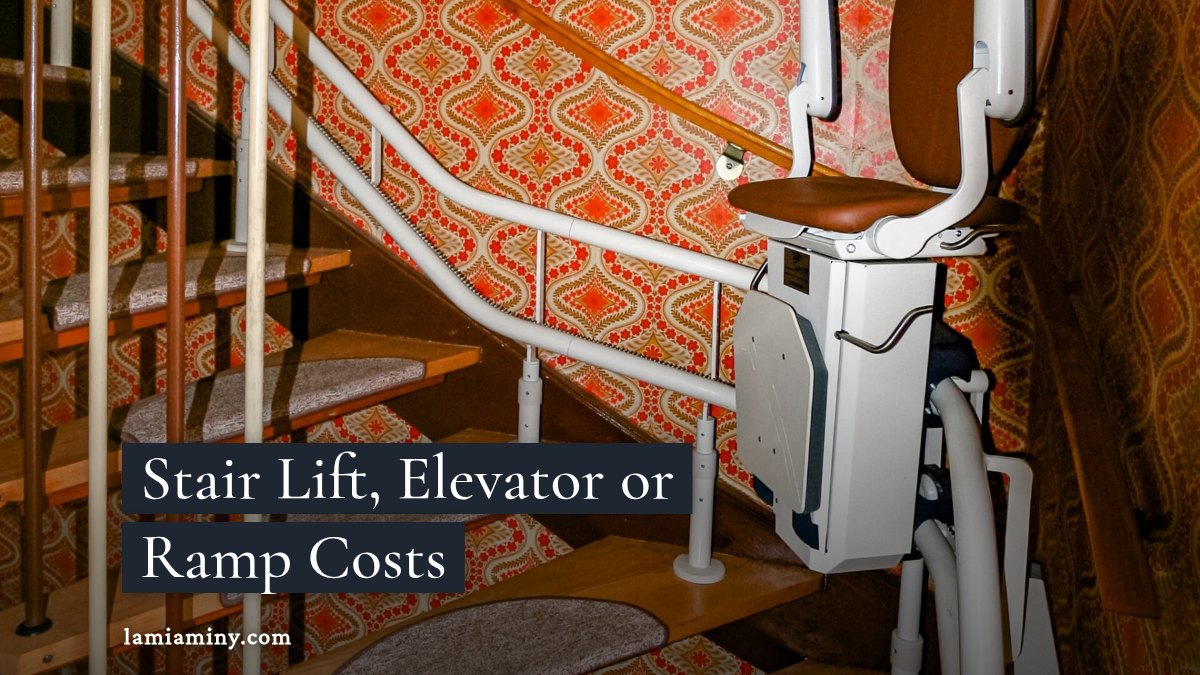
Ask one question before you price anything: can the person who needs help stand up from a chair with little or no help? If so, and the problem is one indoor staircase, a stair lift fits. If they stay in a wheelchair or scooter, a stair lift won't work, because the rider has to transfer onto its seat. Choose a ramp for the front door, or an elevator or lift between floors.
That rule comes from Lifeway Mobility, which does not recommend stair lifts for wheelchair users, and from All American Stairlifts, whose guide lists elevators, ramps, platform lifts and through-floor lifts as wheelchair compatible. Both are stair lift sellers, so read their prices as a starting point for local quotes.
Stair Lift
A stair lift needs no construction. Lifeway Mobility says a straight one can be installed as soon as one day after purchase.
All American Stairlifts puts straight models at $2,800 to $5,500 and curved ones at $8,000 to $15,000. Installation takes 2 to 4 hours for straight and 4 to 8 hours for curved. Rentals commonly run $80 to $180 a month. DIY kits cost $1,500 to $2,500, but the guide says they void most warranties and rule out VA and Medicaid reimbursement.
Home Elevator
A home elevator is a construction project. The guide estimates $20,000 to $75,000 or more including the shaft, with an install of 2 to 6 months that is not reversible. Lifeway says a standard unit can serve up to 5 floor levels, in new or existing homes, and needs coordination with an architect and contractor, which adds cost and time.
Two options sit in between. Vertical platform lifts run $5,000 to $15,000 and install in 1 to 3 days. Through-floor lifts run $15,000 to $30,000 and install in 2 to 5 days. Lifeway says through-the-floor units serve at most two levels and cost less because no hoistway is built. The guide adds that most states require an annual inspection of a home elevator, with maintenance of $300 to $600 a year.
Entry Ramp
Ramps are governed by arithmetic. The guide says ADA standards require a 1:12 slope, so three steps (21 inches) need a 21-foot ramp. Ramps suit outdoor entries of 1 to 5 steps and are impractical between indoor floors.
Modular ramps cost $1,000 to $5,000 and permanent concrete ramps $3,000 to $10,000. Modular aluminum ramps commonly rent for $100 to $300 a month.
Cost and Permit Comparison
Permit rules are local. The public sources found here are California's residential code, the Los Angeles code for private residence elevators, the federal Access Board and one South Carolina county. None addresses stair lifts or through-floor lifts, so the table says so instead of guessing.
| Option | Typical cost | Install time | Usable from a wheelchair | Published permit or code note |
|---|---|---|---|---|
| Straight stair lift | $2,800 to $5,500 | 2 to 4 hours | No | None found |
| Curved stair lift | $8,000 to $15,000 | 4 to 8 hours | No | None found |
| Modular ramp | $1,000 to $5,000 | Not stated | Yes | County building permit |
| Concrete ramp | $3,000 to $10,000 | Not stated | Yes | County building permit |
| Platform lift | $5,000 to $15,000 | 1 to 3 days | Yes | California: ASME A18.1 |
| Through-floor lift | $15,000 to $30,000 | 2 to 5 days | Yes | None found |
| Home elevator | $20,000 to $75,000+ | 2 to 6 months | Yes | California: ASME A17.1/CSA B44 |
The 2025 California Residential Code, effective January 1, 2026, requires private residence elevators to "conform to ASME A17.1/CSA B44, Section 5.3", and platform lifts to comply with ASME A18.1. Los Angeles requires private residence elevators to comply with ASME A17.1-2004 and its municipal code, and prohibits scissors-type car gates. For ramps, Chesterfield County, South Carolina says its Building Codes department issues the building permits required for construction and improvements. The Access Board says private residence elevators are permitted only within a dwelling unit, or as access to a single private residence in multi-unit facilities.
Steps to Hire and Get Permits
The order matters, because the permit depends on the device.
- Apply the rule above: can the person stand from a chair, and is the climb indoors or at the door?
- Call your local building department before you sign and ask whether that device needs a permit. The sources here show permit or code rules for ramps, elevators and platform lifts and say nothing about stair lifts.
- Get quotes from the right trade: a stair lift installer, a ramp builder or general contractor, or an elevator company working with an architect and contractor.
- Ask each installer which code the work follows. In California that is ASME A17.1/CSA B44 for elevators and ASME A18.1 for platform lifts.
- Check coverage. Original Medicare does not cover any of these, though some Medicare Advantage plans may offer home modification benefits.
Even among stair lift sellers the trades overlap less than you might expect. All American Stairlifts says it will point customers to elevator or ramp contractors when those fit better than a stair lift.
Highlights
Which should I install, a stair lift, home elevator or ramp?
A stair lift suits someone who can stand from a chair and faces one indoor staircase. A ramp suits outdoor entries of 1 to 5 steps, and an elevator or lift suits someone who stays in a wheelchair between floors.
What does each option cost?
Straight stair lifts run $2,800 to $5,500, ramps $1,000 to $10,000 depending on type, and home elevators $20,000 to $75,000 or more, per a stair lift seller's guide.
Do I need a permit?
Published rules cover elevators and platform lifts in California and ramp permits in one South Carolina county, but the sources found say nothing on stair lifts. Ask your local building department.
Sources
- Stairlift vs Elevator vs Ramp vs Platform Lift (2026)
- Stair Lifts vs. Home Elevators - Which is Best for Me? | Lifeway Mobility
- Los Angeles Building Code — LAMC Chapter IX § 92.0304 Privat
- R323 Elevators and Platform Lifts — 2025 CRC
- Chapter 4: Elevators and Platform Lifts
- DEPARTMENTS | ChesterfieldCounty