Insulation Upgrade From Attic to Band Joist
What insulation crews do in the attic, walls and basement, which material goes where, and why the work is settled before drywall and equipment.
Nobody toasts the insulation crew at the housewarming. The work vanishes behind drywall, and a house with no cold corner and no draft at the ankles is the only credit it gets. That is the catch. Ramos, at Insul-Techs, a Concord, California, spray foam firm with 25 installers and eight people in the office, puts it bluntly: insulation quality is hard to see once gypsum board covers it, and he says there is no second chance after that. So this walk runs from the attic down to the band joist, following what two working crews have published about their own methods, and it starts with why the timing matters.
Who this walk serves
The two crews here work in western Massachusetts and the Bay Area, not in Miami, Los Angeles or New York, and neither source speaks to a particular city. What carries over is the order of operations. ENERGY STAR advises checking the recommended attic level for your climate zone, air sealing, then adding insulation if needed. The right depth and material in Miami will not match a Massachusetts attic, so ask any crew for the number that fits your zone.
The attic comes first
Most of the savings argument lives up here. According to the ENERGY STAR page, sealing and insulating the attic can save up to 10% on annual energy bills. Tauer, a western Massachusetts contractor that specializes in cellulose, air-seals the thermal envelope at the attic floor before any new material goes down, checking chimneys, bath fans, vent pipes and plumbing chases. Larger openings get one-part foam, caulk, flashing, and scrap lumber or drywall, and can lights get fire-rated covers. Old stained fiberglass helps: the stains mark where air has been leaking.
Loose-fill on the attic floor
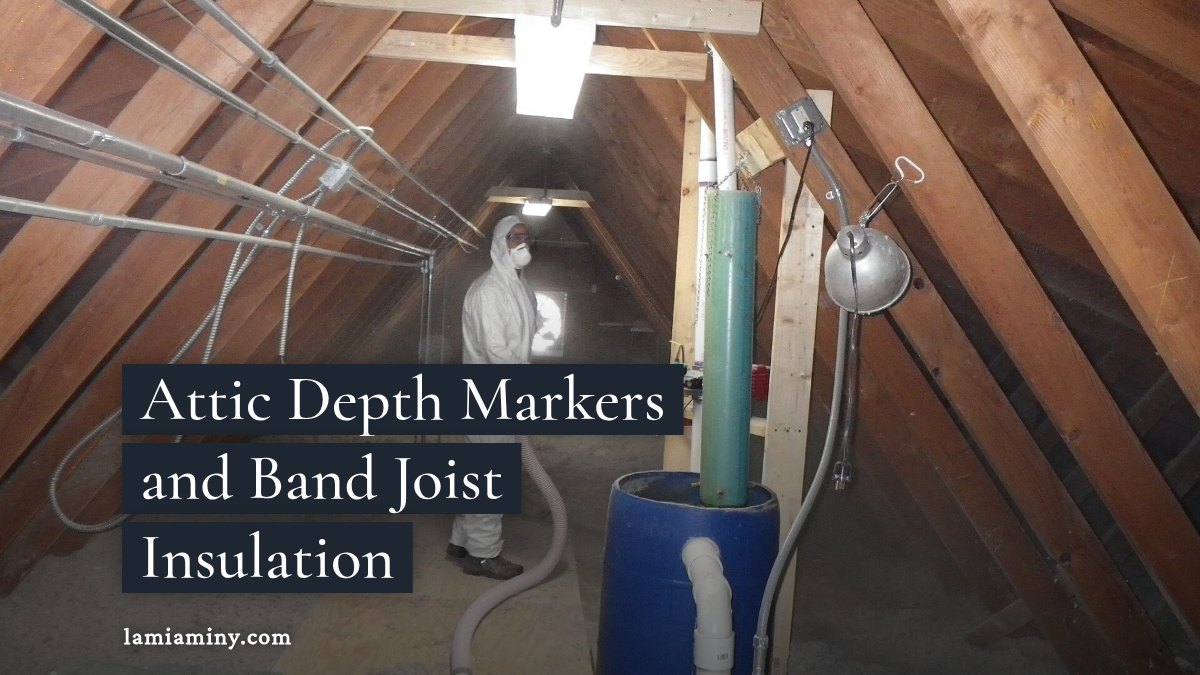
With the leaks closed, attics are most often insulated with loose-fill cellulose blown across the horizontal surface to a set depth. Its R-value is about 3.5 per inch, and it blocks moving air less well than dense-pack, which is why the sealing comes first. It can settle 10 percent or more, so crews blow extra and place depth markers every few feet. Those markers are your proof later.
Walls without gutting them
Closed wall cavities call for dense-pack: cellulose forced into the space under pressure until it is firm, cannot settle and resists air movement. It lets a crew insulate an existing house without tearing it open, but it is slow because every cavity has to be found and filled. The target density is 3.5 to 4 pounds per cubic foot, and filling too fast can fall short or bow out drywall or plaster. Where old batts are in the way, Tauer's crew removes a strip of drywall or sheathing, discards the batts, nets the opening and blows the empty cavities. Netting takes about twice the man-hours of the blowing.
Basement and band joist
The band joist, the rim of the house sitting on the foundation, is where spray foam is often the default. Tauer says dense-pack cellulose alone can insulate and air-seal many of those trouble spots, and calls cellulose the most efficient material in dollars per unit of R-value (Tauer's claim, not an independent ranking). The other camp is closed-cell spray foam. Insul-Techs describes it as central to meeting code because of its high R-value per inch, low permeability, and role as both insulation and air barrier. The catch is that it also acts as a vapor retarder, so placement relative to the dew point matters or condensation can become a risk.
Before you hire, and before the heat pump
ENERGY STAR recommends a certified heat pump and lists it among six upgrades for existing homes. The sources do not set a sequence between insulation and equipment, so that is a question for your contractor and HVAC installer together. What they do show is the cost of lateness: Insul-Techs says late insulation can delay drywall crews, ceiling grid installation and final close-in, so it stresses early ordering and coordination with the general contractor. Worth asking any crew: does it air-seal before it insulates, and how will depth or density be checked? Insul-Techs says its crews are trained to track lift thickness, substrate conditions and curing times. ENERGY STAR points homeowners to BPI-certified contractors or Owens Corning's Certified Energy Experts. And ask about cleanup: spray cellulose is messy, and on residential jobs cleanup can exceed the setup time saved.
Back in the attic
Tauer's account of an attic job starts outside, with a box truck whose powerful blower mixes fiber with air and sends it through a hose about 3 inches across. Upstairs, the floor has already been sealed around the chimneys, fans and pipes. The depth markers go in every few feet, because the cellulose can settle 10 percent or more, and the markers will still be standing after it does.
Highlights
What does an insulation crew do first in an attic?
It air-seals the attic floor, checking chimneys, bath fans, vent pipes and plumbing chases, before adding insulation. Loose-fill cellulose is then blown to a set depth, with extra allowed for settling.
Which material goes in walls and basements?
Closed wall cavities are usually filled with dense-pack cellulose. Band joists can take dense-pack cellulose or closed-cell spray foam, depending on the installer and the moisture risks.
How much can attic work save?
According to the ENERGY STAR page, sealing and insulating the attic can save up to 10% on annual energy bills.